

Optional background music while you read
Huntington’s disease first entered my life when I was a preteen.
My first clear memory of Huntington’s was when my mom returned from visiting my nana, who had recently been hospitalized with complications from the disease. She was experiencing significant motor dysfunction, cognitive decline, and psychiatric symptoms. I remember my mom being deeply distressed and traumatized by what she had witnessed.
From that moment forward, Huntington’s was not something my family talked about openly. It carried too much fear, uncertainty, and devastation. My mom decided she never wanted to find out whether she had inherited the disease.
For most of my life, my understanding of Huntington’s was rooted in my mom’s experiences, thoughts, and fears. As I grew older, I began researching the disease and learning more about how it had existed within our family. Still, I never truly believed Huntington’s would become part of my own life.
From my mid-teens into my mid-twenties, a significant amount of my mental, emotional, and physical energy went toward supporting and caring for my mom. At the time, she was experiencing complex and increasingly impactful mental health challenges. My family did everything we could with the knowledge and resources we had, but as her condition worsened, I eventually experienced significant burnout.
In my mid-twenties, I made the incredibly difficult decision to step back from caretaking and from my relationship with my mom. I knew I needed to prioritize my own well-being, but that decision came with tremendous guilt. I still loved and cared deeply about my mom, and it was difficult knowing my family would have to navigate her increasingly complex needs without me.
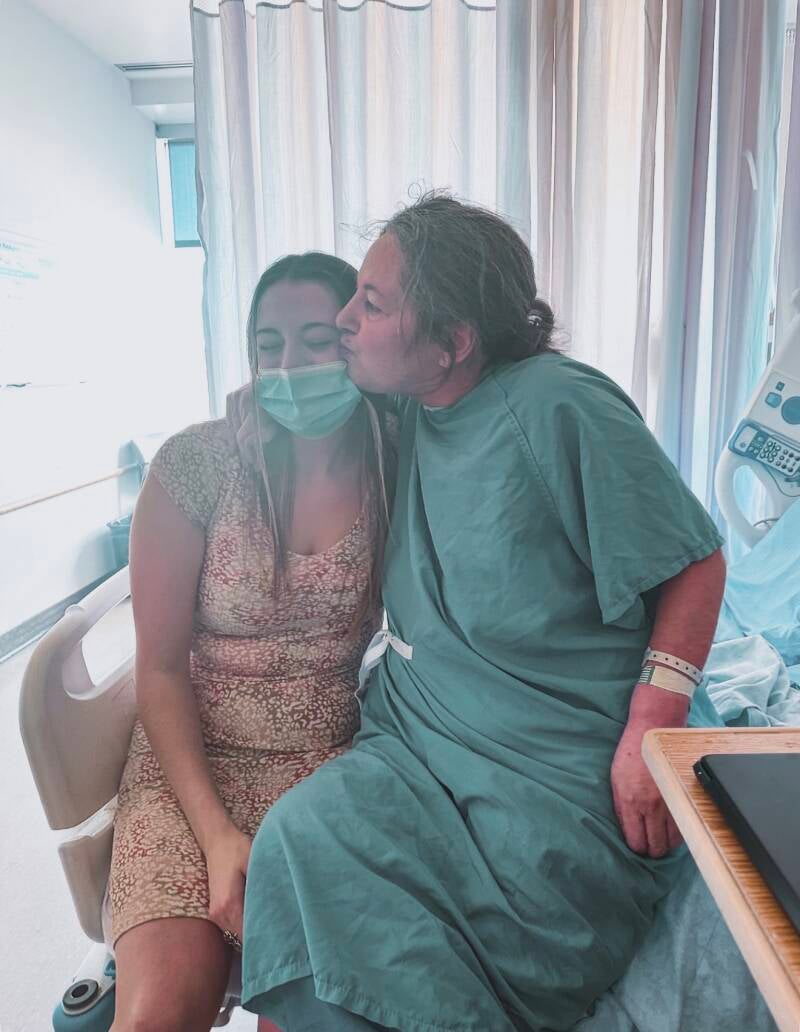
Eventually, my mom was no longer able to care for herself independently. My family fought tirelessly to advocate for her and get the professional support she desperately needed. She eventually moved into a care home where she could receive multidisciplinary care from trained professionals.
It was during this time that my family was finally able to have my mom tested for Huntington’s disease. She was gene positive and already in the middle to later stages of the disease.
This was when Huntington’s became even more personal for me.
Receiving confirmation that my mom was gene positive was heartbreaking. Yet, after everything that had happened over the previous two decades, deep down I wasn’t surprised. After spending so much of my life living with uncertainty, I finally knew the truth.
And with that truth came another reality: I had a 50% chance of inheriting Huntington’s disease myself.
I spent a long time considering genetic testing. There were so many things to think about - mental health, relationships, family planning, career, finances, insurance, and the many unknowns that come with knowing whether you have inherited a genetic disease.
It wasn’t until about a year later that I finally felt ready. I had strong relationships around me, felt grounded in my life, and believed I could face whatever result came my way. Growing up, I had always felt that fear came from uncertainty. I knew I wanted to take ownership of my future rather than continue living in the unknown.
I went into genetic testing believing I would be gene negative. I had always been relatively healthy and active, and I couldn’t conceptualize being gene positive.
At my third genetic testing appointment, the genetic counselor told me that I had inherited the Huntington’s disease gene.
I was gene positive.
When the appointment ended, it felt like my entire world collapsed in seconds. I fell to the floor in shock. I began hyperventilating, my body was shaking, and I remember feeling completely numb.
I reached out to the people I loved one by one, and each time I shared the news, my heart broke all over again.
For a long time, I felt like everything I knew about myself and my future had been replaced by uncertainty. I questioned my identity, my existence, and my mortality. I wondered how I was supposed to accept Huntington’s as part of myself when it was something I had feared my entire life.
But while all of that was happening, so was my life.
I still had date nights with my partner. I still had friends and family to laugh with. I had a workplace where I could contribute, places I wanted to travel, concerts to attend, photographs to take, food to try, and a body I wanted to move.
There was still so much life happening outside of Huntington’s.
Slowly, those parts of my life helped create a sense of normalcy again. I began to understand that being gene positive could be one part of my identity without becoming my entire identity. I could acknowledge Huntington’s while still allowing myself to experience joy, love, ambition, curiosity, and hope.
I am still learning how to hold both of those realities at the same time.
After several months, I felt ready to join Huntington’s disease support groups and begin counseling. At first, I was quiet. I didn’t share much. I was mostly grateful to listen and learn.
For the first time outside of my experience with my mom, I was meeting people who understood Huntington’s through their own lived experiences. It was incredibly valuable, inspiring, and healing. These people began to redefine what I understood about Huntington’s - not only the disease itself, but the ways people could continue to build meaningful lives, experience joy, find community, and thrive.
Eventually, I began sharing more of my own story.
One of the most meaningful moments happened during one of my first support group sessions. A question was asked about a topic where I was the only person with direct experience. My first instinct was to stay quiet. I questioned whether my perspective mattered.
But eventually, I decided to speak.
Not because I was an expert or believed my experience was more important than anyone else’s, but because I knew what it felt like to sit in fear and uncertainty without knowing where to turn.
After I finished sharing, several people expressed their gratitude for my honesty and vulnerability.
That moment changed something for me.
For the first time, I understood that perhaps the adversity I had experienced could become something meaningful. Maybe my story could help someone else feel less alone.
Since becoming gene positive, I have intentionally sought out people within the Huntington’s community whose character I admire, whose authenticity inspires me, and whose outlook on life I want to carry with me.
I owe so much of my healing and growth to the people who have shared their stories with me. Their honesty gave me permission to be honest. Their vulnerability gave me permission to be vulnerable. Their hope helped me find my own.
I am still learning what it means to live with Huntington’s disease in my life. I don’t have all the answers, and I don’t know what the future will hold. But I know I don’t want fear to write my story for me.
I want to keep learning, healing, growing, and showing up - for myself and for others.
Most importantly, I want to pass forward the kindness, honesty, and support that others gave me when I needed it most.
If you are carrying fear, grief, uncertainty, or questions about your own journey, I hope you know there is room for hope alongside all of it.
You are not alone.
Your story matters.
And there is still so much life waiting to be lived.