

26 or fewer
Negative
Will not develop Huntington’s disease.
Huntington’s disease (HD) is an inherited condition that affects the brain and gradually changes the way a person moves, thinks and behaves.
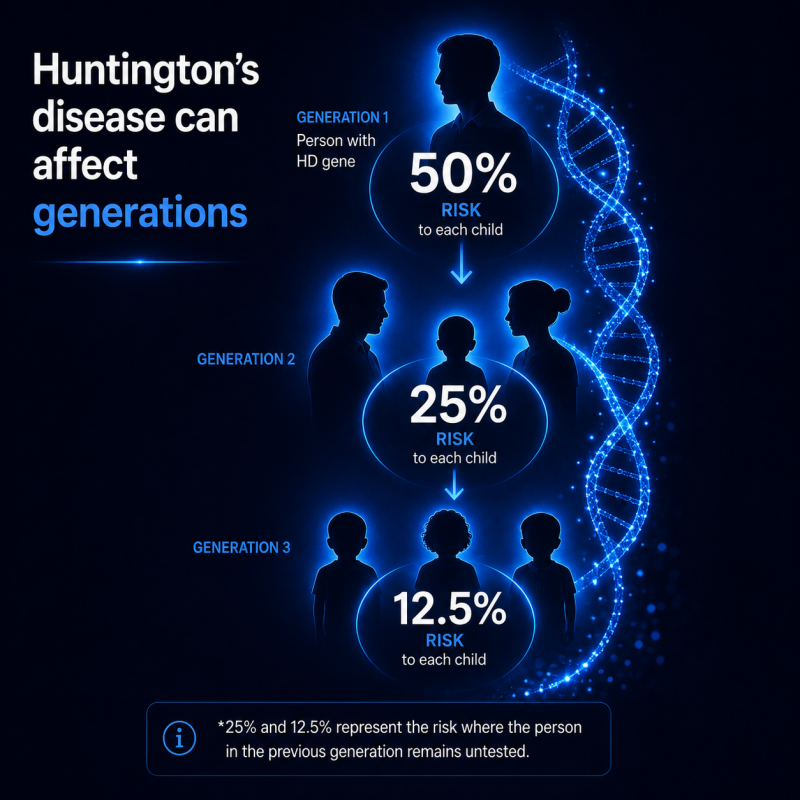
It is caused by a change in a single gene. If a parent has the Huntington’s gene, each of their children has a 50% chance of inheriting it.
HD affects everyone differently. Symptoms usually develop gradually and can include involuntary movements, changes in balance and coordination, difficulties with speech and swallowing, changes in thinking and concentration, and changes in mood or behaviour.
There is currently no cure for Huntington’s disease, but treatments, specialist care and support can help manage symptoms and maintain quality of life.
Huntington’s doesn’t only affect the person with the disease. Its impact can reach across entire families and generations.
Huntington's disease doesn't just affect the person who carries the altered gene. Its effects can spread through partners, children, carers, relatives, friends and generations yet to come.
↓ Tap or click each part of the ripple to explore who Huntington's can affect.
The diagnosis belongs to one person, but those closest to them often begin living with Huntington's too.
A boyfriend, girlfriend, husband, wife or partner may have no genetic risk themselves — but Huntington's can still have an enormous effect on their life.
A child of a parent who carries the altered Huntington's gene has a 50% chance of inheriting it. That knowledge can influence major life decisions even when they are completely well.
A carer can be a husband, wife, partner, parent, child, sibling, relative or friend. Their life can change enormously as HD progresses.
Huntington's can influence decisions about having children long before a pregnancy begins.
The ripple doesn't stop with the immediate family. Many other people can become part of life with Huntington's disease.
Early signs of Huntington’s disease vary from person to person. They can include changes in mood or behaviour, difficulty concentrating or planning, clumsiness, balance problems and small involuntary movements. Symptoms usually develop gradually and may initially be quite subtle.
Huntington’s disease can affect movement, thinking and behaviour. Symptoms can include involuntary movements, problems with balance and coordination, difficulties with speech and swallowing, changes in concentration and memory, and changes in mood or personality.
Huntington’s disease is a progressive, life-limiting condition. Symptoms worsen over time and there is currently no cure. However, treatments, specialist care and support can help manage symptoms and maintain quality of life.
Huntington’s disease affects everyone differently, so there is no exact timescale. People can live for many years after symptoms begin, and the rate at which the condition progresses varies considerably from person to person.
Huntington’s disease can affect far more than physical movement. It can change communication, independence, relationships and everyday family life. Every family’s experience is different.
Visit our Family Stories page to hear directly from people whose lives have been affected by Huntington’s disease.
Huntington’s disease is caused by a change in a gene that can be passed from parent to child.
If a parent carries the Huntington’s gene, each child has a 50% chance of inheriting it.
That chance is the same for every pregnancy. Having one child who inherits the gene does not change the chances for another child.
A person who does not inherit the altered Huntington’s gene cannot pass it on to their children.
This is why Huntington’s disease can affect generation after generation of the same family.
One gene can affect an entire family tree.
The genetic change that causes Huntington’s disease is called a CAG repeat expansion. A genetic blood test counts how many times the CAG sequence repeats within the HTT gene. This repeat number helps show whether someone will develop Huntington’s disease.
CAG stands for cytosine, adenine and guanine — three chemical letters found in DNA.
Everyone has an HTT gene, which provides the instructions for making a protein called huntingtin. Within the gene is a repeated CAG sequence. Huntington’s disease is caused when this sequence repeats too many times.
Will not develop Huntington’s disease.
Will not develop Huntington’s disease, but there is a very small chance the repeat could expand when passed to a child.
May develop Huntington’s disease, but not everyone does.
Will develop Huntington’s disease at some point.
Source: Huntington’s Disease Association
Huntington’s disease affects the brain, but its symptoms can appear in many different ways.
The disease can gradually affect movement, thinking and behaviour, and no two people will experience Huntington’s in exactly the same way.
Some changes may be noticeable early, while others develop slowly over many years.
As Huntington’s progresses, everyday things many of us take for granted, walking, speaking, eating, making decisions and communicating, can become increasingly difficult.
Huntington’s isn’t just a movement disorder. It can affect almost every part of a person’s life.

MOVEMENT
Huntington’s can cause involuntary movements, often called chorea, as well as problems with balance, coordination and walking.
As the disease progresses, speaking, swallowing and everyday physical tasks can also become more difficult.

THINKING
HD can affect concentration, memory, planning and decision-making.
Processing information may become slower, and tasks that were once straightforward can become increasingly difficult.

BEHAVIOUR & EMOTIONS
Changes in mood, motivation, behaviour and personality can be part of Huntington’s disease.
Depression, anxiety, irritability, apathy and difficulty controlling emotions can all occur.
Huntington’s disease can affect a person’s balance, coordination, movement and speech. To somebody who doesn’t understand the condition, these symptoms may look like drunkenness. People living with HD can find themselves stared at, laughed at or judged while simply trying to go about their day. Before you stare, whisper or make a comment, please pause, the person in front of you may be living with a neurological condition that already makes everyday life difficult enough. A little understanding can make an enormous difference.

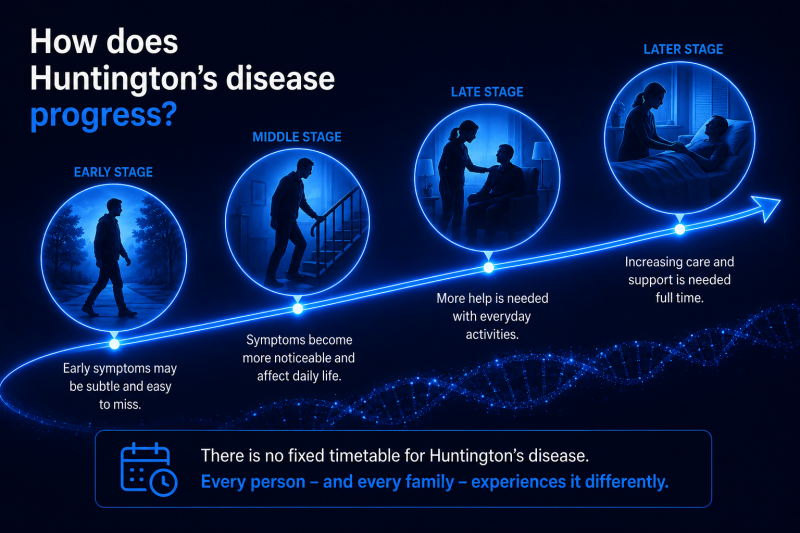
Huntington’s disease is progressive, which means symptoms gradually change and become more difficult over time.
The speed of progression is different for everyone. Some people may live with relatively mild symptoms for many years, while others may experience changes more quickly.
As the disease progresses, a person may need increasing help with everyday activities such as walking, washing, dressing, eating and communicating.
In the later stages, swallowing can become particularly difficult and specialist support may be needed to help manage nutrition, communication and comfort.
There is no fixed timetable for Huntington’s disease. Every person and every family experiences it differently.
Understanding your options
In the later stages of Huntington’s disease, families may face an extremely difficult decision: whether to use a feeding tube or continue eating and drinking by mouth with the risks acknowledged.
This is one of the cruellest and hardest decisions Huntington’s can force a family to face. After speaking with professionals and considering Sarah’s own wishes, we decided that she would continue eating and drinking by mouth. Every sip and every spoonful frightens me because I know the risks, but Sarah still needs to eat and drink—and there is no completely safe or easy answer.
I am not a medical professional and this section is not intended as advice. I am simply sharing the decision we made, what we considered and what living with that decision really feels like. There is no right or wrong choice; I only hope our experience helps another family feel less alone when having these difficult conversations.
A short extract from our family’s film about the decision we faced for Sarah.
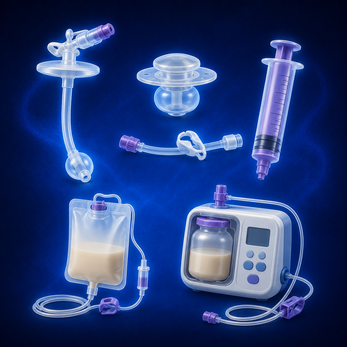
A PEG is a tube placed through the abdomen into the stomach so liquid nutrition, water and many medicines can be given without swallowing them by mouth.
✓What it may help with
!Things to consider
The illustration shows examples of commonly used feeding equipment. The device and feeding arrangement provided will vary from person to person.
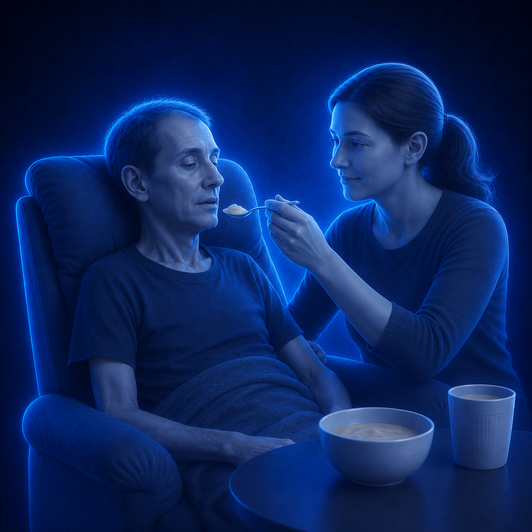
This is professionally known as eating and drinking with acknowledged risks, although many families will recognise the term “risk feeding”.
✓What it may preserve
!Things to consider
Decisions about swallowing and nutrition should be discussed with the person’s neurologist, GP, Speech and Language Therapist, dietitian and wider care team. The Huntington’s Disease Association provides specialist information to help families understand the options.
This section shares one family’s lived experience and general information only. It is not a substitute for individual medical advice. Never change someone’s food, drink consistency, feeding method or care plan without guidance from the professionals involved in their care.
At the moment, there is no cure for Huntington’s disease and there is no treatment that can stop or reverse the condition.
However, that does not mean there is nothing that can be done.
Medication can help manage some symptoms, while physiotherapy, speech and language therapy, dietetic support, mental health support and specialist Huntington’s care can all help maintain quality of life.
Research into Huntington’s disease continues around the world, including work looking at treatments that target the genetic cause of the disease.
There may not yet be a cure, but treatment, care and support can make a real difference.
Finding out that Huntington’s disease is in your family can bring many questions, not only about the person who has been diagnosed, but about what it could mean for you, your children and future generations.
If one of your parents carries the Huntington’s gene, you have a 50% chance of inheriting it. But being at risk does not mean you have to be tested.
Predictive genetic testing is a personal decision. In the UK, testing is normally carried out through a specialist genetics or Huntington’s disease service, with counselling and appointments beforehand so that you understand what knowing your result could mean.
Whether you choose to be tested or not, information and support are available.
You don’t have to make these decisions alone.